Executive Summary: A New Interaction Layer for Digital Commerce
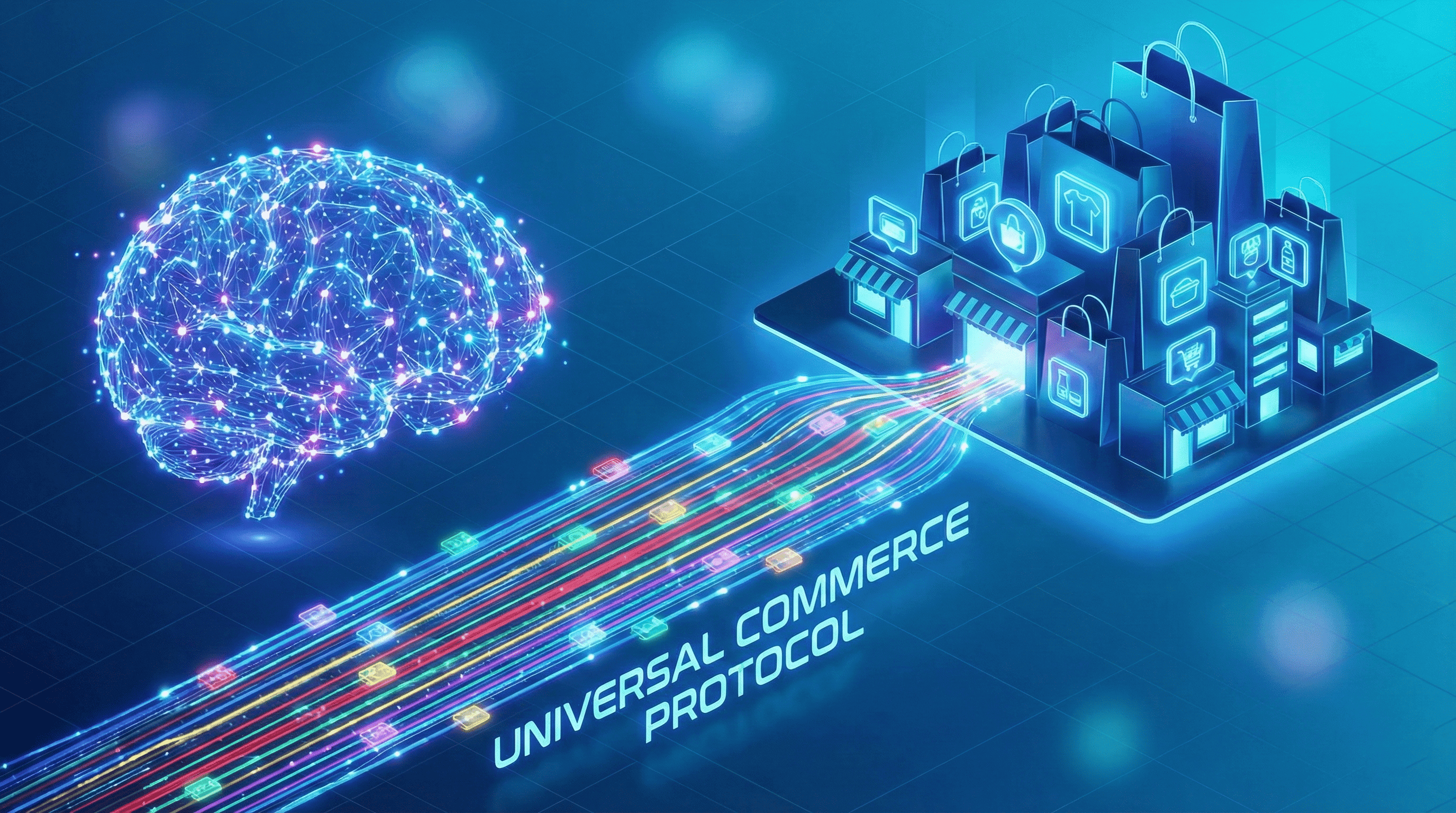
Google's Universal Commerce Protocol (UCP) is designed for the next phase of ecommerce: a world where AI agents do more than search, compare, and recommend. They can discover products, negotiate supported options, assemble a cart, and complete a transaction on behalf of a user.
The protocol matters because today's commerce stack is fragmented. Every agent would otherwise need a custom integration with every merchant platform. UCP reduces that "N x N" integration problem into one shared language for product discovery, checkout sessions, payments, and merchant capabilities.
UCP is backed by Google, Shopify, Walmart, Target, Wayfair, Etsy, and other commerce players. That gives it immediate distribution and makes it more than a technical experiment. For retailers, it creates a path to participate in agentic commerce without surrendering the customer relationship to a single marketplace.
Why UCP Matters
For two decades, digital commerce has depended on humans acting as the integration layer. A shopper searches, opens tabs, compares options, enters payment details, and manually completes checkout. Generative AI changes that expectation. Users increasingly want outcomes, not lists of links.
Before UCP, AI assistants could describe products but struggled to execute a reliable purchase. They could not consistently verify real-time inventory, apply loyalty discounts, confirm shipping options, or complete payment without handing the user back to a website. That execution gap kept AI in an advisory role.
UCP is Google's attempt to close that gap. It turns commercial websites into agent-readable endpoints and gives merchants a standard way to expose checkout, order tracking, catalog, discount, and payment capabilities.
The Retailer Coalition
The launch partners reveal the strategic direction. Shopify, Walmart, Target, Etsy, and Wayfair all have an interest in preventing agentic commerce from collapsing into one dominant marketplace. UCP supports a federated model: agents can transact across many merchants, while each merchant remains the merchant of record.
For Shopify merchants, this is especially powerful. If Shopify exposes UCP capabilities at the platform layer, millions of independent stores can become agent-ready without building custom AI integrations.
Technical Architecture
 UCP technical architecture
UCP is built around capability-based negotiation. Instead of assuming every merchant supports the same checkout flow, an agent first discovers what a merchant can do.
The process starts with a standard discovery endpoint:
/.well-known/ucp
That manifest can declare supported capabilities, payment handlers, authentication requirements, and extensions such as loyalty points, store pickup, or scheduled delivery.
From there, an agent and merchant negotiate the transaction shape. If both sides support discount codes, the agent can expose that option. If the merchant does not support a capability, the agent should not invent it. This reduces the kind of "feature hallucination" that would otherwise damage trust in AI commerce.
Checkout Models
UCP supports two common checkout paths.
Native checkout keeps the transaction inside the AI interface. The merchant provides product, cart, shipping, and payment data through APIs, while the agent renders the user experience.
Embedded checkout hands the user to a merchant-controlled web view when a purchase requires special handling, such as prescriptions, high-value custom configuration, or extra compliance steps. The key is that UCP preserves session state so users do not need to restart the purchase.
AP2: The Trust and Payment Layer
 AP2 agent payment protocol
UCP describes what is being bought. Google's Agent Payments Protocol (AP2) addresses how payment authorization should work when an AI agent acts for a person.
AP2 introduces signed mandates: tamper-resistant proofs of user intent. A cart mandate can confirm that a human approved a specific basket and price. An intent mandate can authorize a future purchase under strict conditions, such as "buy this item if the price falls below a set amount."
That distinction is essential. Payments need deterministic authorization, while language models are probabilistic. AP2 gives banks, card networks, merchants, and agents a verifiable record of what the user allowed.
Implications for Brands and Retailers
UCP changes the optimization target. In traditional search, brands optimize pages for human clicks. In agentic commerce, brands also need structured data, accurate inventory, clear policies, stable APIs, and machine-readable commercial rules.
Retailers should begin by auditing product data quality, checkout reliability, return policy clarity, and payment compatibility. The brands that make their commerce systems easier for agents to understand will be more likely to appear in AI-mediated purchase flows.
Practical Readiness Checklist
- Keep product catalogs structured and current.
- Make inventory, shipping, returns, and pricing rules machine-readable.
- Prepare for OAuth-style account linking and secure consent flows.
- Review payment handling and fraud models for agent-initiated transactions.
- Treat agent discoverability as a new layer of SEO and commerce operations.
UCP is still early, but its direction is clear. The question is no longer whether AI agents will participate in shopping. The question is how quickly merchants can make their systems trusted, discoverable, and transaction-ready for them.